Showing posts with label Excerpts. Show all posts

Wednesday, 9 April 2014

Sacco & Vanzetti


“If it had not been for these things, I might have lived out my life talking at street corners to scorning men. I might have died, unmarked, unknown, a failure. Now we are not a failure. This is our career and our triumph. Never in our full life could we hope to do such work for tolerance, for justice, for man's understanding of man as now we do by accident. Our words — our lives — our pains — nothing! The taking of our lives — lives of a good shoemaker and a poor fish-peddler — all! That last moment belongs to us — that agony is our triumph.”

Statement attributed to Vanzetti by Philip D. Stong, a reporter for the North American Newspaper Alliance who visited Vanzetti in prison in May of 1927 shortly before he and Sacco were executed.

Wednesday, 29 January 2014

Existentialism Is a Humanism


Those who appeal to the wisdom of the people – which is a sad wisdom – find ours sadder still. And yet, what could be more disillusioned than such sayings as “Charity begins at home” or “Promote a rogue and he’ll sue you for damage, knock him down and he’ll do you homage”? We all know how many common sayings can be quoted to this effect, and they all mean much the same – that you must not oppose the powers that be; that you must not fight against superior force; must not meddle in matters that are above your station. Or that any action not in accordance with some tradition is mere romanticism; or that any undertaking which has not the support of proven experience is foredoomed to frustration; and that since experience has shown men to be invariably inclined to evil, there must be firm rules to restrain them, otherwise we shall have anarchy.

Jean-Paul Sartre, Existentialism Is a Humanism


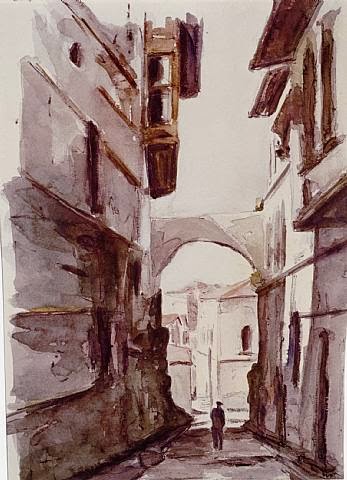
(Picture: Old Ankara, Burhan Dogancay) 

Sunday, 20 October 2013

Quixotic Orwell


Orwell can only be understood as an essentially quixotic man...He defended, passionately and as a matter of principle, unpopular causes. Often without regard to reason he would strike out against anything which offended his conceptions of right, justice and decency, yet, as many who crossed lances with him had reason to know, he could be a very chivalrous opponent, impelled by a sense of fair play that would lead to public recantation of accusations he had eventually decided were unfair. In his own way he was a man of the left, but he attacked its holy images as fervently as he did those of the right. And however much he might on occasion find himself in uneasy and temporary alliance with others, he was - in the end - as much a man in isolation as Don Quixote. His was the isolation of every man who seeks the truth diligently, no matter how unpleasant its implications may be to others or even to himself.

George Woodcock, The Crystal Spirit : A Study of George Orwell


(Picture: Don Quixote, Gustave Dore)

Monday, 14 October 2013

Nothing short of complete victory


It is not for this little moment of time we are fighting, not for our own little bodies and their warmth; it is for all those who come after, for all times. Oh, men, for the love of them don't turn up another stone on their heads, don't help to blacken the sky. If we can shake that white-faced monster with the bloody lips that has sucked the lives out of ourselves, our wives, and children, since the world began, if we have not the hearts of men to stand against it, breast to breast and eye to eye, and force it backward till it cry for mercy, it will go on sucking life, and we shall stay forever where we are, less than the very dogs.

John Galsworthy, Strife


(Picture: Wild pilgrimage, Lynd Ward)

Sunday, 13 October 2013

Modern School


I would like to call the attention of my readers to this idea: All the value of education rests in the respect for the physical, intellectual, and moral will of the child. Just as in science no demonstration is possible save by facts, just so there is no real education save that which is exempt from all dogmatism, which leaves to the child itself the direction of its effort, and confines itself to the seconding of its effort. Now, there is nothing easier than to alter this purpose, and nothing harder than to respect it. Education is always imposing, violating, constraining; the real educator is he who can best protect the child against his (the teacher's) own ideas, his peculiar whims; he who can best appeal to the child's own energies.
[…]

Monday, 8 July 2013

Transitions


Every transition from major to minor in a sonata, every transformation of a myth or a religious cult, every classical or artistic formulation was, I realized in that flashing moment, if seen with a truly meditative mind, nothing but a direct route into the interior of the cosmic mystery, where in the alternation between inhaling and exhaling, between heaven and earth, between Yin and Yang, holiness is forever being created.

Hermann Hesse, The Glass Bead Game


(Picture: Blue sky painting, Acrylic on canvas, Sam Francis)

Sunday, 16 June 2013

An address of a ''traitor''


Your honor, I have stated in this court that I am opposed to the form of our present government; that I am opposed to the social system in which we live; that I believe in the change of both but by perfectly peaceable and orderly means...

I am thinking this morning of the men in the mills and factories; I am thinking of the women who, for a paltry wage, are compelled to work out their lives; of the little children who, in this system, are robbed of their childhood, and in their early, tender years, are seized in the remorseless grasp of Mammon, and forced into the industrial dungeons, there to feed the machines while they themselves are being starved body and soul...

Saturday, 8 June 2013

Ὁ ἄνθρωπος μὲ τὸ γαρύφαλο


Σήμερα τὸ στρατόπεδο σωπαίνει.
Σήμερα ὁ ἥλιος τρέμει ἀγκιστρωμένος στὴ σιωπὴ
ὅπως τρέμει τὸ σακάκι τοῦ σκοτωμένου στὸ συρματόπλεγμα.
Σήμερα ὁ κόσμος εἶναι λυπημένος.
Ξεκρέμασαν μία μεγάλη καμπάνα καὶ τὴν ἀκούμπησαν στὴ γῆ.
Μὲς στὸ χαλκό της καρδιοχτυπᾶ ἡ εἰρήνη.
Σιωπή. Ἀκοῦστε τούτη τὴν καμπάνα.
Σιωπή. Οἱ λαοὶ περνοῦν σηκώνοντας στοὺς ὤμους τους
τὸ μέγα φέρετρο τοῦ Μπελογιάννη.

Γιάννης Ρίτσος

Sunday, 3 February 2013

Human advantages

Advantage! What is advantage? And will you take it upon yourself to define with perfect accuracy in what the advantage of man consists? And what if it so happens that a man's advantage, sometimes, not only may, but even must, consist in his desiring in certain cases what is harmful to himself and not advantageous...You see, you gentlemen have, to the best of my knowledge, taken your whole register of human advantages from the averages of statistical figures and politico-economical formulas. Your advantages are prosperity, wealth, freedom, peace-and so on, and so on.

Fyodor Dostoyevsky, Notes from the Underground

What a perpetual disappointment is actual society

We seek our friend not sacredly, but with an adulterate passion which would appropriate him to ourselves...All association must be a compromise, and, what is worst, the very flower and aroma of the flower of each of the beautiful natures disappears as they approach each other. What a perpetual disappointment is actual society, even of the virtuous and gifted! After interviews have been compassed with long foresight, we must be tormented presently by baffled blows, by sudden, unseasonable apathies, by epilepsies of wit and of animal spirits, in te heyday of friendship and thought. Our faculties do not play us true, and both parties are relieved by solitude.

Ralph Waldo Emerson, Friendship

Sunday, 13 January 2013

I will breathe after my own fashion


Thus the state never intentionally confronts a man's sense, intellectual or moral, but only his body, his senses. It is not armed with superior will or honesty, but with superior physical strength. I was not born to be forced. I will breathe after my own fashion. Let us see who is the strongest.

Henry David Thoreau, Civil Disobedience


(Picture: Portrait of Henry David Thoreau, Felix Vallotton)